BFPCA Media Release, 17 February 2026
- Up to $100 million a year in health and sleep-related harms imposed on Brisbane residents.
- A night curfew would cost around $10 million or less – a fraction of the community damage.
- The airport’s growth projections in the Draft Master Plan 2026 are “highly unlikely” to be realised.
- Health benefits alone exceed $100 million annually if a curfew is introduced.
- Reduced property values linked to aircraft noise are estimated at $200–$350 million annually.
- Only 2.5% of flights operate overnight – yet hundreds of thousands of residents bear the cost.
- Freight can be shifted to Wellcamp Airport at minimal cost.
- Legislated curfews are in place in Sydney, Adelaide, Gold Coast and Melbourne (Essendon).
A night flight curfew at Brisbane Airport would not damage the economy and its growth figures are over-egged, new independent economic analysis by Professor John Quiggin from The University of Queensland has found. Contradicting decades of aviation industry messaging, the report finds the modest economic cost of a curfew is dwarfed by the enormous health bill generated by aircraft noise in the 2032 Olympic host city.
The report asks who bears the cost of Brisbane airport operations and aircraft noise. It finds that a small share of late-night flights – roughly 2.5% of total movements – generates concentrated commercial benefit to Brisbane Airport Corporation and the economy but the costs are shouldered by communities and outweigh benefits. The airport socialises the costs by spreading noise pollution across hundreds of thousands of residents exposed to repeated night-time sleep disruptions.
The economic cost of a 10pm – 6am curfew would be modest – in the order of $10 million per year or less – while the community benefits would be substantially larger. Without a curfew, health-related costs alone are estimated at around $100 million annually. Broader impacts on residential amenity and property values are estimated at $200–$350 million annually. Put together, the economic burden imposed by overnight aircraft noise rises significantly.
The analysis also addresses Brisbane Airport Corporation’s Draft Master Plan 2026. Passenger growth projections underpinning continued 24-hour expansion are tested against recent performance. Over the past decade, both domestic and international passenger numbers have remained broadly flat. Post-pandemic recovery has been slower and structurally different from previous growth cycles, with business travel lagging. The report concludes that the Master Plan’s forecasts are unlikely to be realised in the time frame projected.
Prof. Quiggin’s findings challenge the long-standing narrative that Brisbane’s 24-hour operations are economically indispensable. Other Australian capitals such as Sydney and Adelaide operate successfully with legislated night-flight restrictions. The report argues that introducing a curfew would bring Brisbane into line with established national and international practice while delivering a clear net public benefit.
The economic question, the report concludes, is no longer whether a curfew is affordable. It is whether continuing unrestricted night operations can be justified at all.
The original night-time curfew in Brisbane was lifted in 1988 with the launch of Brisbane Airport in its current location. Since then, Brisbane Airport Corporation (BAC) has argued that imposing a night curfew would damage the economy without ever providing a proper cost-benefit analysis as is done in Prof. Quiggin’s new report.
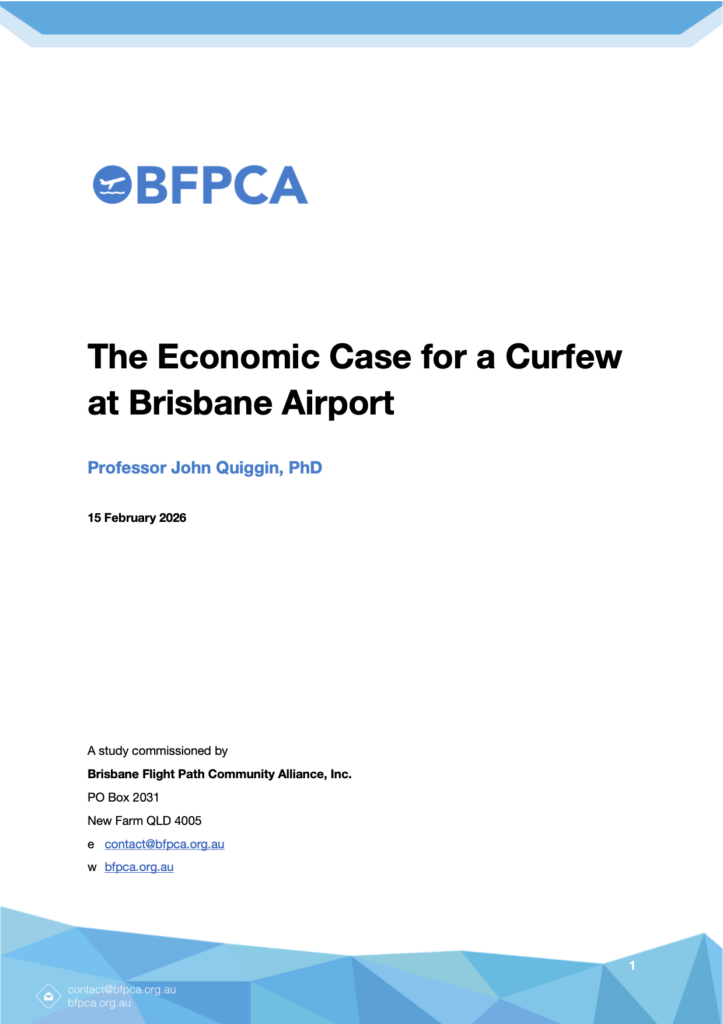
The full report is available here.
Quotes Attributable to Prof. John Quiggin
“A curfew would not ground the economy but it would finally let Brisbane residents sleep.”
“On conservative estimates, Brisbane residents are collectively losing up to $100 million per year in the form of sleep disruption, elevated health risks, reduced quality of life, and depressed land values.”
“The costs of a curfew are modest, of the order of $10 million per year, or even less. By contrast, the potential health and economic benefits of a curfew are valued at $50 million or more.”
“The imposition of a curfew would yield health benefits from reduced coronary attacks and other severe effects of around $100 million per year. Hedonic land valuations, which incorporate less severe effects such as annoyance, yield much higher values, ranging from $200 million to $350 million. A curfew would also yield benefits in the form of reduced public subsidies.”
“The persistent suggestion that aviation should be exempt from regulatory constraint because it is an ‘essential service’ is analytically unsound. Industries that generate externalities – whether transport, manufacturing, or energy – are commonly subject to operating limits, particularly during sensitive night hours. It is time to bring Brisbane Airport into line with the rest of the country. A curfew is standard policy, not radical reform.“
“It is highly unlikely that the growth projections of the Master Plan will be realised.“
About Prof. John Quiggin
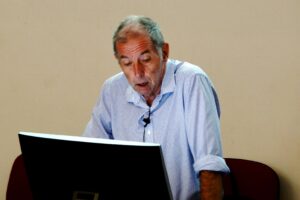
Professor John Quiggin, PhD, is a Professor of Economics at The University of Queensland and one of Australia’s most prominent public intellectuals in economic policy. He is internationally recognised for his contributions to decision theory under uncertainty (including rank-dependent expected utility), environmental economics, risk analysis, and public policy.
He is a Fellow of the Econometric Society, a Fellow of the Academy of the Social Sciences in Australia, and a Distinguished Fellow of the Australian Agricultural and Resource Economics Society. He has also held visiting appointments at leading institutions including Harvard University, the University of Maryland, and the London School of Economics.
Professor Quiggin has authored more than 1,500 publications, including over 200 refereed journal articles and multiple books. His work spans decision theory, environmental and resource economics, production economics, climate change economics, and the economics of innovation and growth. He is widely cited in both academic and policy debates.
In addition to his academic research, Professor Quiggin is a leading commentator on Australian and international economic policy. He has written extensively on climate policy, privatisation and microeconomic reform, financial regulation, infrastructure economics, public ownership, employment policy, and water reform in the Murray–Darling Basin.
His recent books include:
- Economics in Two Lessons: Why Markets Work So Well and Why They Can Fail So Badly (Princeton University Press, 2019), which offers a concise framework for understanding both the strengths and limitations of markets; and,
- After Neoliberalism (ANU Press, 2024), which examines the evolution and future of economic policy in the post-neoliberal era.
He is also a regular contributor to public debate through columns, essays, and media commentary, including for The Conversation.
About BFPCA
With the launch of Brisbane Airport’s New Parallel Runway on 12 July 2020 came a new airspace design and flight paths that concentrate aircraft noise over densely populated residential areas.
Brisbane Airport and Airservices Australia sold this project to Brisbane communities suggesting the New Parallel Runway will enable them to prioritise “over water” operations that direct planes away from residential areas. The CEO Gert-Jan de Graaff is on the record saying, “the net effect of aircraft flying over the city will decrease.”
Brisbane families and communities are suffering from excessive noise pollution and associated health and related impacts from Brisbane Airport’s new flight paths launched in July 2020. The Aircraft Noise Ombudsman report, the Brisbane Airport PIR Advisory Forum (BAPAF) and flight path design consultants TRAX International have all confirmed that Brisbane communities were misled using flawed noise modelling, deceiving community engagement, and offered inadequate noise abatements.
Brisbane Flight Path Community Alliance (BFPCA) came together in 2020 to fight back on behalf of all Brisbane families and communities experiencing this noise pollution.
For more background information, visit: https://bfpca.org.au/